

Dear community,
In honor of Mental Health Awareness Month, I’m so pleased to feature the groundbreaking and deeply compassionate way my friend, Dr. Nzinga Harrison, approaches treatment for substance use disorders — which are still among the most stigmatized health conditions to exist.
💫 Spread the light with Dr. Devika B. Conversations that dispel stigma and stereotypes and instead, spread hope and light — also on YouTube, Apple, Spotify
Because stigma festers in the dark and scatters in the light
About Dr. Nzinga Harrison:
Nzinga Harrison, MD, is a board-certified physician with specialties in psychiatry and addiction medicine. She is also the Chief Medical Officer and cofounder of Eleanor Health, an innovative mental health and addiction treatment company. Dr. Harrison holds an adjunct faculty appointment at the Morehouse School of Medicine and sits on the Practice Management and Regulatory Affairs Committee for the American Society of Addiction Medicine. She has written a brilliant book called Un-Addiction that walks through 6 mind-changing conversations about addiction and recovery that could save a life.
My top takeaways from this conversation and Dr. Harrison's book:
Contrary to popular belief, 75% of people with substance use disorder do recover. And one-year relapse rates for high blood pressure and asthma are the same or higher than that for addiction.
Upholding abstinence-only as the goal path for recovery from substance use disorder is dangerous. Instead, most people with substance use disorder recover to controlled use — and it's paramount for people to set their own recovery goals.
Up to 60% of the risk for substance use disorder is inherited.
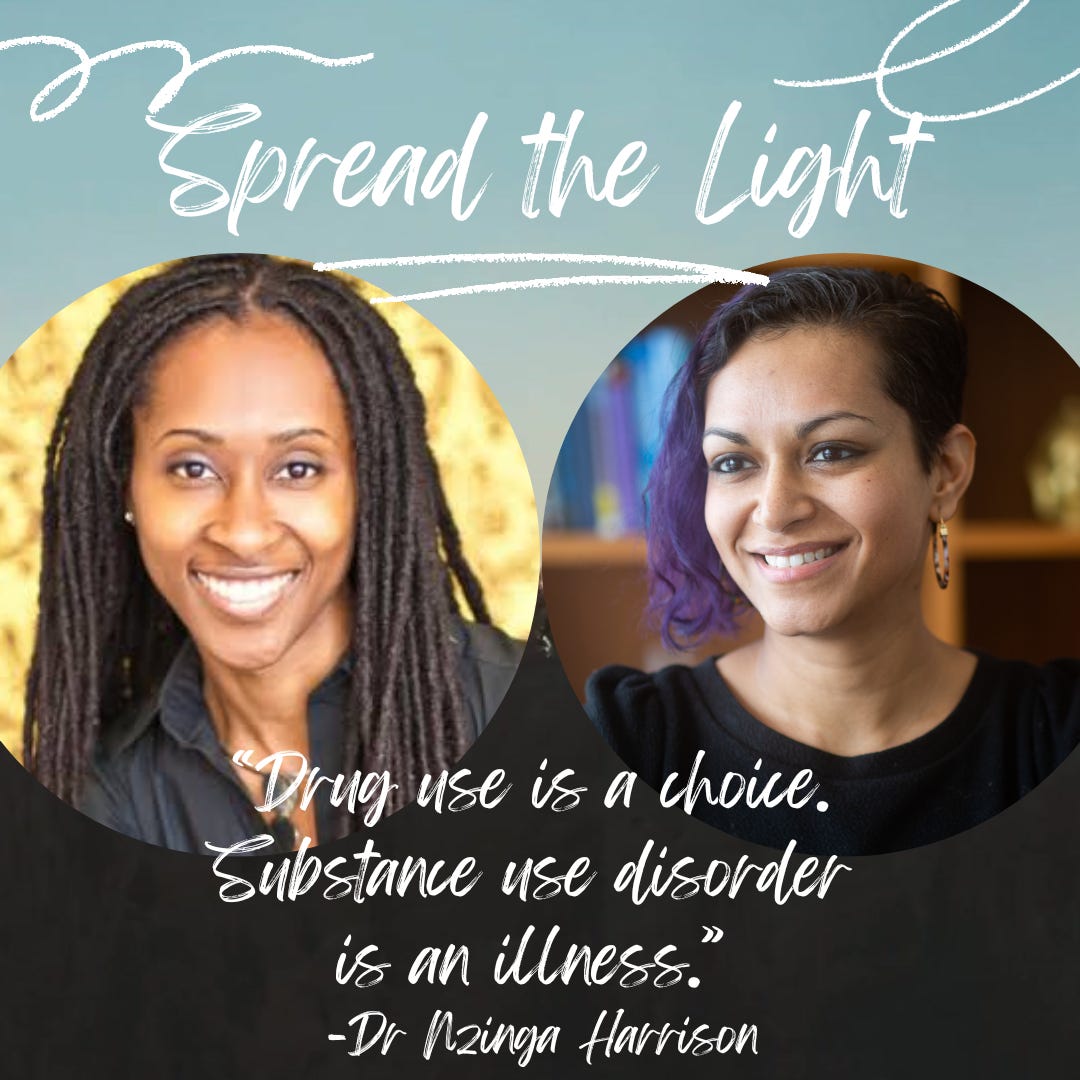
"Drug use is a choice. Substance use disorder is an illness."
"...the more we can get away from this tough love, disconnection, shameful, stigmatizing approach that we've been trained in — the more we can get to compassionate boundaries for psychological, emotional, and physical safety — the faster we can get to recovery."
Trigger warning: In this episode, we talk about substance use disorders, adverse childhood experiences and mental illness.
Above, you’ll find the audio and video recording of the podcast episode and on the Substack app/website, you’ll find a transcript. If you’d prefer to watch this conversation on YouTube, please click here.
Click here to catch up on other Spread the light columns, in addition to other posts organized by column type, going back to our newsletter’s launch in January 2023.
If you or a loved one needs help for a mental health crisis, don’t hesitate to call or text 988 — or reach them online here. Find other resources here, search for a US treatment facility here, and find a US-based therapist here.
Wishing you light,
Dr. Devika Bhushan
Dr. Nzinga Harrison's groundbreaking approach to substance use disorder treatment
DB: In the book Un-Addiction, you talk about being a medical student taking care of patients awaiting liver transplants, only to learn that people with alcohol use disorders have to be in remission for at least 3 years to be eligible, while patients with other diseases are not held to the same standard. “The lives of people who use alcohol and drugs don’t matter to the health care system,” you write. Talk about this moment and anything else that led you to focusing your career on addiction recovery.
NH: Yeah, I think that really is the moment.
I went to medical school with the intention to be a pediatric surgeon. And you know, you have to rotate through all of the different specialties. And so I went to my six weeks’ psychiatry rotation, dismayed that I even had to do it because I was like, I could be doing surgery right now.
What I really found was even before the system doesn't care about the lives of people who use alcohol and drugs, was: the system really was built in a way that was legitimately harming and killing people that had mental health conditions. I was raised an activist and that really tapped my activism bone.
I just went home feeling so heavy every day because we did all of the liver transplant pre-transplant psychiatry evaluations, and it just became shockingly, amazingly clear that if your liver disease was from anything other than substance use disorder, it was easy to just say, psychiatrically clear — going on the list. No problem.
But when a person had a substance use disorder, whether in remission for years or not, it was like we were legitimately having to put on our hardest-core advocacy skills with other physicians to prove, it felt like, why this person deserved to live.
And that just really bothered me deep in my soul. This was 24 years ago. A very small kernel of people believed and understood substance use disorder as an illness. Instead, it was seen as a moral failing: You make bad decisions. We can't trust you to take care of this liver — this idea that people don't recover from substance use disorders. [But 75% of people with addiction do recover. And one-year relapse rates for high blood pressure and asthma are the same or higher than that for addiction.]
I just legitimately came away feeling like the system doesn't care if these people die or not.
As community members come to us at Eleanor Health, they carry all of that stigma internalized, right? Like, they believe they're bad people. They believe they don't have willpower. They don't trust in their own intuition. They don't understand their ability to make decisions and their right to make decisions about their own behaviors and their health.
And so I tell this story in the book about the St. Kitts monkeys.


